Gary
T. Rochelle, PhD
The
Carol and Henry Groppe Professor in Chemical Engineering
| Office: |
CPE 5.458 |
Mailing Address: |
| Phone: |
(512) 471-7230 |
The University of Texas at Austin |
| Fax: |
-- |
Department of Chemical Engineering |
| Email: |
gtr@che.utexas.edu |
1 University Station C0400 |
| UT Mail: |
C0400 |
Austin, TX 78712-0231 |
Research
Group
Presentation Made to Prospective Graduate Students 2008
Educational
Qualifications:
Ph.D., University of California at Berkeley;
UT Separations Research Program
Focus:
Control of air pollution by acid gases, carbon
dioxide, and air toxics, CO2 capture, flue gas desulfurization,
acid gas treating, CO2 mass transfer with chemical reaction,
electrolyte thermodynamics, reaction kinetics in aqueous
solutions.
Research:
We are developing a fundamental understanding of the kinetic
and mass transfer phenomena in aqueous technologies for
air pollution control and acid gas treating. Limestone slurry
scrubbing is the dominant technology for sulfur dioxide
removal.
Limestone slurry
and other aqueous solutions may also be effective for removal
of mercury from waste gases.
We are quantifying
the absorption of mercury as a function of solution composition
in a highly characterized wetted wall contactor. The results
are interpreted with the theory of mass transfer with fast
reaction in the boundary layer.
Our group is quantifying
the thermodynamic and kinetic phenomena in technologies
for removing hydrogen sulfide and carbon dioxide by absorption/stripping
with alkanolamine solutions. This technology has grown in
importance with new amine alternatives and increased interest
in marginal natural-gas resources and CO2 capture from flue
gas. We are developing a comprehensive model with a rigorous
representation of excess Gibbs energy that is able to simulate
simultaneously vapor-liquid equilibria, heats of reaction,
freezing point depression and other thermodynamic data.
Acid-gas absorption
into alkanolamine solutions occurs by mass transfer with
chemical reaction. We are measuring the absorption rates
of the acid gases as a function of gas and solution composition
for common and innovative amines. Parameters representing
reaction kinetics, diffusion coefficients, and equilibria
are extracted from the experimental data. The available
data and models of equilibria and mass transfer are integrated
into a rate-based simulation of the absorption/stripping
process. The model must simultaneously account for the complex
equilibria and rate processes while converging heat and
material balances at every point in the absorber and stripper.
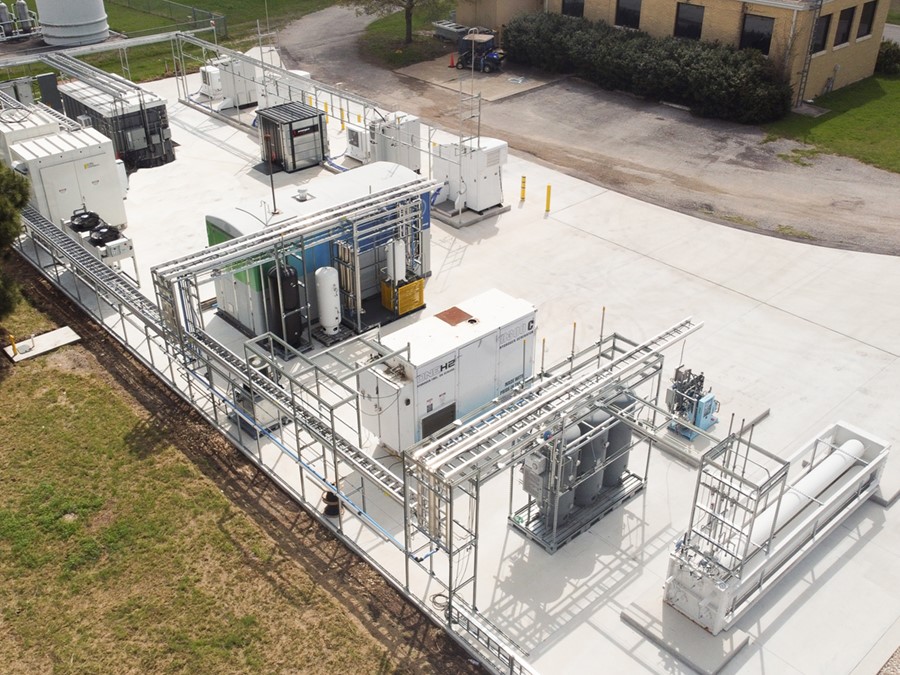
Innovative solvents that we develop for CO2 capture are
being tested in a pilot scale facility on the Pickle Research
Campus. These results will validate the integrated models
of absorber/stripper performance and demonstrate innovative
process concepts.
Selected
Publications
- "A Thermodynamic Model of Methyldiethanolamine-CO2—
H2S— Water", Ind. Eng. Chem. Res., 36, 3944-3953
(1997) (with M. Posey).
- "Hg Absorption in Aqueous Oxidants Catalyzed by
Hg (II)," Ind. Eng. Chem. Res., 37, 380-387, 1998
(with L. Zhao).
- “Research Needs for CO2 Capture from Flue Gas
by Aqueous Absorption/Stripping,” Final report on
DOE P.O. No. DE-AF26-99FT01029, January 17, 2001 (with.
S. Bishnoi, S. Chi, H. Dang, and J. Santos)
- “Oxidative Degradation of Monoethanolamine.”
Revised for Ind. Eng. Chem. Res., May 2002. (with S. Chi).
- "Rate-Based Modeling of Reactive Absorption of
CO2 and H2S into Aqueous Methyldiethanolamine," Ind.
Eng. Chem. Res., 37(10), 4107-4117 (1998) (with M. Pacheco).
- “Absorption of Carbon Dioxide into Aqueous Piperazine:
Reaction Kinetics, Mass Transfer and Solubility,”
Chem. Eng. Sci., 55 (2000) 5531-5543 (with s. Bishnoi).
- S. Bishnoi/G.T. Rochelle, “Thermodynamics of piperazine/methyldiethanolamine/water/carbon
dioxide,” IECR; 2002; 41(3); 604-612 (with S. Bishnoi).
- "Hg Absorption in Aqueous Hypochlorite," Chem.
Eng. Sci., 54, 655-662 (1999) (with L.B. Zhao).
< Go back