Engineer receives $400,150 to model thin film patterns
March 7, 2006

Aerospace engineer Rui Huang at The University of Texas at Austin has received a $400,150 Early Career Development (CAREER) award to investigate how patterns evolve in thin materials being considered for applications such as flexible video displays and nanoelectronic devices.

CAREER awards are the National Science Foundation’s most prestigious awards for young teacher-scholars expected to be future academic leaders.

Huang’s research could help manufacturers understand how to control the way surface patterns form in thin films (microscopically thin layers of material). This will help in developing technological applications of materials with ordered structures at the micrometer to the nanometer scale. The work could also improve the reliability and performance of thin-film coatings that protect surfaces such as turbines in airplane engines.

Huang will develop mathematical models and computer simulations of two types of patterns that evolve in thin films. The first involves a hard film less than 100 nanometers thick coated onto a plastic or other soft material. The soft nature of the underlying material (substrate) allows the more rigid surface film to wrinkle, producing diverse patterns. By altering the stress in the thin film, the materials’ properties and other parameters, Huang will explore potential ways to control wrinkle patterns.

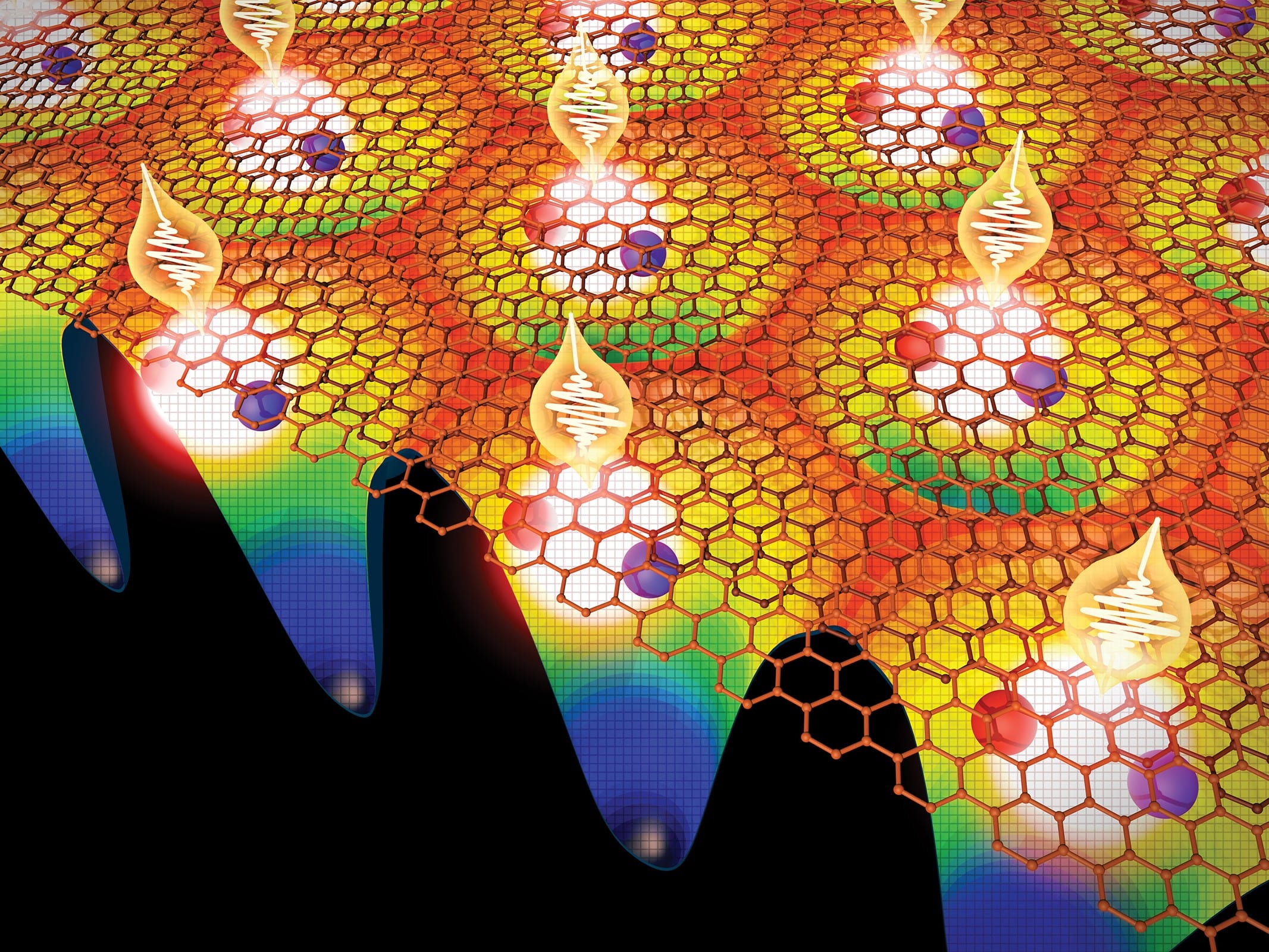
The second type of pattern involves a thin film layer of semiconductor crystal material atop a substrate of another semiconductor crystal. The mismatch of the internal lattice structures between the two crystals creates stress in the film, driving its atoms to assemble into nanometer-size clusters called quantum dots. Huang’s research on the evolution of these self-assembling clusters could lead to novel engineering techniques for directing this process to produce ordered quantum-dot arrays. Potential applications include flash memory and optoelectronic devices.

Huang also plans to apply what he learns to evaluating the mechanical properties of ultrathin films, working with collaborators at the National Institute of Standards and Technology.

“We will work closely with several experimental groups to validate our models and simulations and to help them develop applications of these thin film materials,” Huang said, noting that many natural substances develop similar patterns, such as skin wrinkling and the folding of layered rocks. 

As part of the grant’s educational component, Huang is developing a graduate level course for engineering mechanics students and others to learn about the mechanics of thin films and the dynamics of their pattern evolution. 

NOTE: For a photo of Dr. Huang, go to: www.engr.utexas.edu/news/action_shots/pages/huang.cfm

Email this article to a friend


About UT's Cockrell School of Engineering:

The University of Texas at Austin's Cockrell School of Engineering ranks among the top six public engineering schools in the United States. With the nation's fourth highest number of faculty elected members of the National Academy of Engineering, the School's more than 7,000 students gain exposure to the nation's finest engineering practitioners. Appropriately, the School's logo, an embellished checkmark used by the first UT engineering dean to denote high quality student work, is the nation's oldest quality symbol. The School maintains a Web site at http://www.engr.utexas.edu

Archives