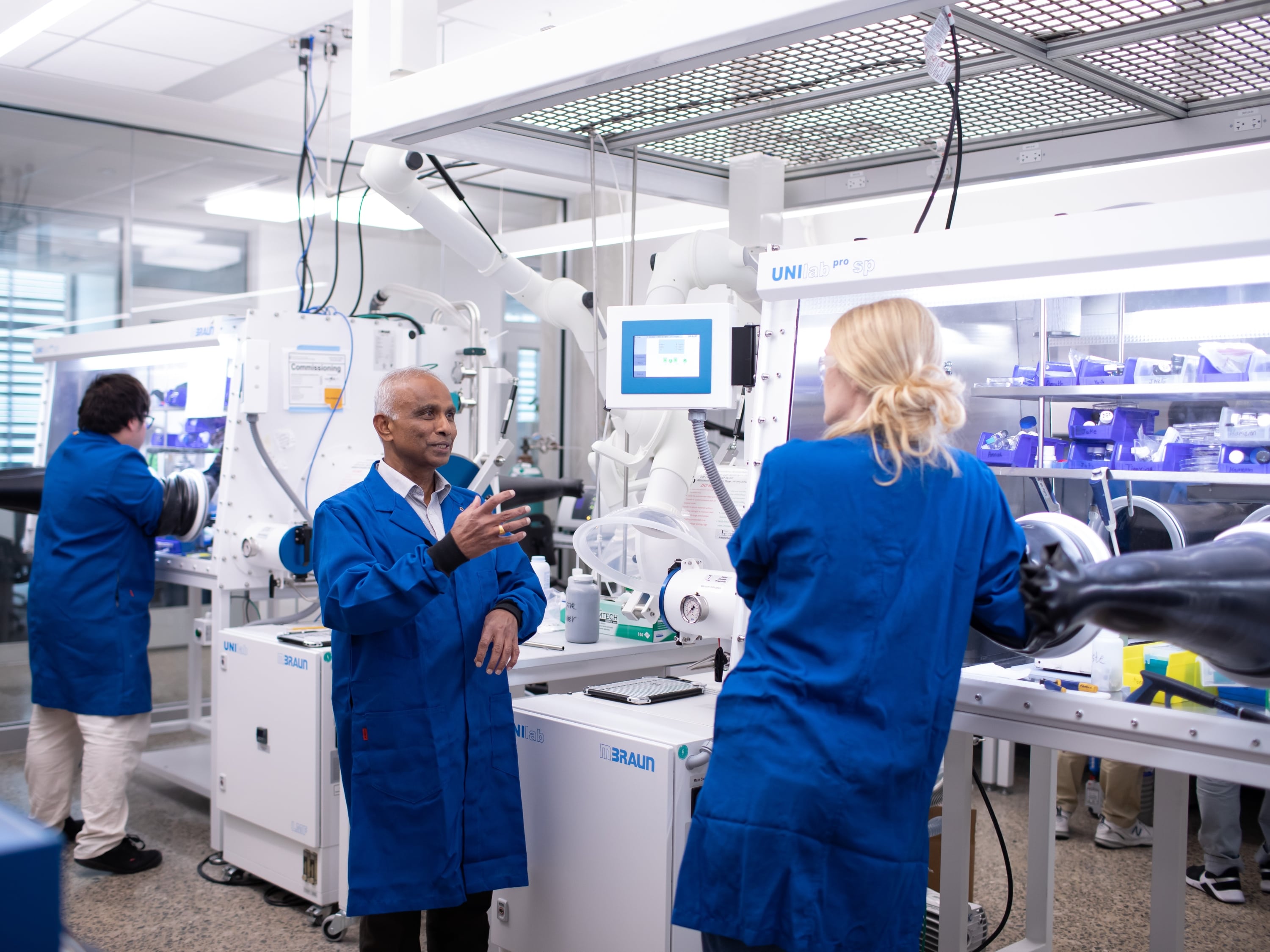
Lighter power sources for communication devices expected from $5.8 million grant to engineers, chemists

June 27, 2007

A technology to produce fuel cells that serve as easily replaced, lightweight power sources for cell phones, laptops, MP3 players and other devices is being developed by a team led by a mechanical engineer at The University of Texas at Austin.


A team of nine faculty led by Dr. Arumugam “Ram” Manthiram has received $3.5 million from the U.S. Office of Naval Research for three years to develop novel materials and manufacturing processes for methanol-powered fuel cells. The naval office is expected to provide $2.3 million more for two additional years on this Multi-disciplinary University Research Initiative grant about this alternative to lithium ion batteries.


Power sources based on methanol-powered fuel cells could weigh about half as much as their lithium ion counterparts. The methanol-powered fuel cells would also permit consumers and military personnel to carry replacement methanol cartridges and avoid recharging devices using electrical outlets.


“Soldiers wouldn’t have to look for an electrical socket to recharge their batteries,” said Manthiram, “and fuel cells would significantly reduce the weight soldiers have to carry.”


To investigate methanol-powered fuel cells, the holder of the B.F. Goodrich Endowed Professorship in Materials Engineering is working with seven university colleagues and a mechanical engineering colleague at Stanford University.


The other University of Texas at Austin participants are: Dr. Allen Bard (the Norman Hackerman-Welch Regents Chair in Chemistry); Dr. Joseph Beaman (the Earnest F. Gloyna Regents Chair in Engineering and chair of the Department of Mechanical Engineering); Dr. Christopher Bielawski (assistant professor of chemistry and biochemistry); Dr. David Bourell (the Temple Foundation Endowed Professor No. 2); Dr. Venkat Ganesan (the Chevron Centennial Teaching Fellow in Chemical Engineering); Dr. Jeremy Meyers (assistant professor of mechanical engineering, and a member of the university’s Center for Electrochemistry along with Bard and Manthiram); and Dr. Kristin Wood (the Cullen Trust for Higher Education Endowed Professor in Engineering  No. 1). The Stanford University participant is: Dr. Friedrich Prinz, the Rodney H. Adams Professor in the School of Engineering.


Manthiram, Bard, and other group members will develop cheaper, more efficient materials for prompting the chemical reactions that generate electricity in methanol-powered fuel cells. Cheaper, more efficient membranes that serve as proton transport medium for these chemical reactions will also be studied. To develop an efficient manufacturing process, Beaman and colleagues will use computer-aided selective laser sintering and predictive process controls for producing components such as carbon plates that control the flow of methanol and oxygen to membrane-electrode assemblies. These membrane-electrode assemblies, which generate electricity, will also be produced using other types of advanced manufacturing processes.


The researchers will also study how to integrate the different components that would be manufactured to produce an efficient methanol-powered fuel cell system.


For photos of lead investigator Ram Manthiram and several University of Texas at Austin students from participating labs, go to: http://www.engr.utexas.edu/news/action_shots/pages/manthiram_fuel%20cells_2007.cfm

Email this article


About the Cockrell School of Engineering:

The Cockrell School ranks among the top ten engineering programs in the United States and aspires to move into the top five. With the nation's fourth highest number of faculty members elected to the National Academy of Engineering, the Cockrell School's more than 7,000 students work with many of the world's finest engineering educators and researchers. This environment prepares graduates to become engineering leaders and innovators working for the betterment of society.

Archives